Name: Whitefield Limited
ASX Code: WHF
Dividend yield: 3.87% fully franked
Market Cap: $401m
Price: $4.62 (19/07/2018)
Pre – Tax NTA (30th June): 5.01
Premium/Discount: 9.38% discount
Whitefield Limited is a conventionally structured Listed Investment Company that was founded in 1923 and has over $400 million in assets. It has an internal investment committee that guides its investment process which focuses largely on industrial stocks, providing a point of difference to many other LICs on the market. Whitefield is primarily owned by the Gluskie family and their related entities. Angus Gluskie is the CEO and chief investment officer. Whitefield initially started as an investor in mortgages before focusing on equities since 1949 and listing in 1970.
How does Whitefield Limited Invest?
Whitefield is somewhat different to many other LICS in that it focuses solely on industrial stocks, this means it has very little or no exposure to energy or mining. The benchmark for Whitefield is the ASX200 Industrials accumulation index. This index is somewhat unusual (and hard to find online) as it represents all stocks that are not in the ASX200 Resources index. “Back in the day” analysts used these indexes to quickly compare how the high risk resources stocks (mining, energy and agriculture) and ‘safe’ industrials (railroads, manufactoring, banking, etc) stocks were performing. Typically these industrial stocks are very consistent in their earnings per share and dividends, this is reflected in Whitfield having never decreased is dividend in the last 28 years.
Whitefield analysts focus on industrial companies as they feel their earnings and competitive edge is easier to evaluate, compared to resource stocks who’s profits are usually largely tied to commodity prices which are more random.
Whitefield states;
Australian Industrial Shares (being all sectors of the market other than resources) have characteristics that assist Whitefield in delivering upon its objectives of return and reliability. Over many decades Australian industrial shares have delivered both a higher level of income and a higher total return with lower volatility than the broad market.
Australia’s position as a politically safe and geographically attractive country is likely to continue to result in higher population growth and higher affluence than for many other economies. These trends are likely to provide a supportive base over an extended period for the Australian industrial economy.
Whitefield uses an index enhanced strategy to try and beat its benchmark. This means they own most stocks in the underlying benchmark however take overweight and underweight positions in stocks relative to the index to tilt the portfolio in a direction best placed for outperformance. An index enhanced strategy like this is unlikely to strongly outperform like some concentrated fund managers (such as CLV featured in the last LIC review), conversely it will not greatly underperform either if the tilts are wrong.
Whitefield’s investment edge stems from its highly disciplined and repeatable investment process which focuses on the use of data and quantitative analysis to find opportunities in the market. The long tenure and experience of the executive committee (average experience of 20+ years) gives confidence that they will be able to continue this moving forward.
Portfolio, performance and Price
The long to medium term investment performance of the portfolio has been strong and has slightly outperformed its benchmark of the ASX200 Industrials index, giving confidence that the investment strategy of Whitefield can stand up over the medium term.

The dividend flow of the company has also been exemplary with a 28 year record of either increasing or maintaining its dividend! This exceeds even other LIC heavy weights such as AFIC and ARGO.

The long term returns of the company have also been very impressive, with the 2018 Annual report stating that an investment of $10,000 when they first listed would be worth $1,790,000.
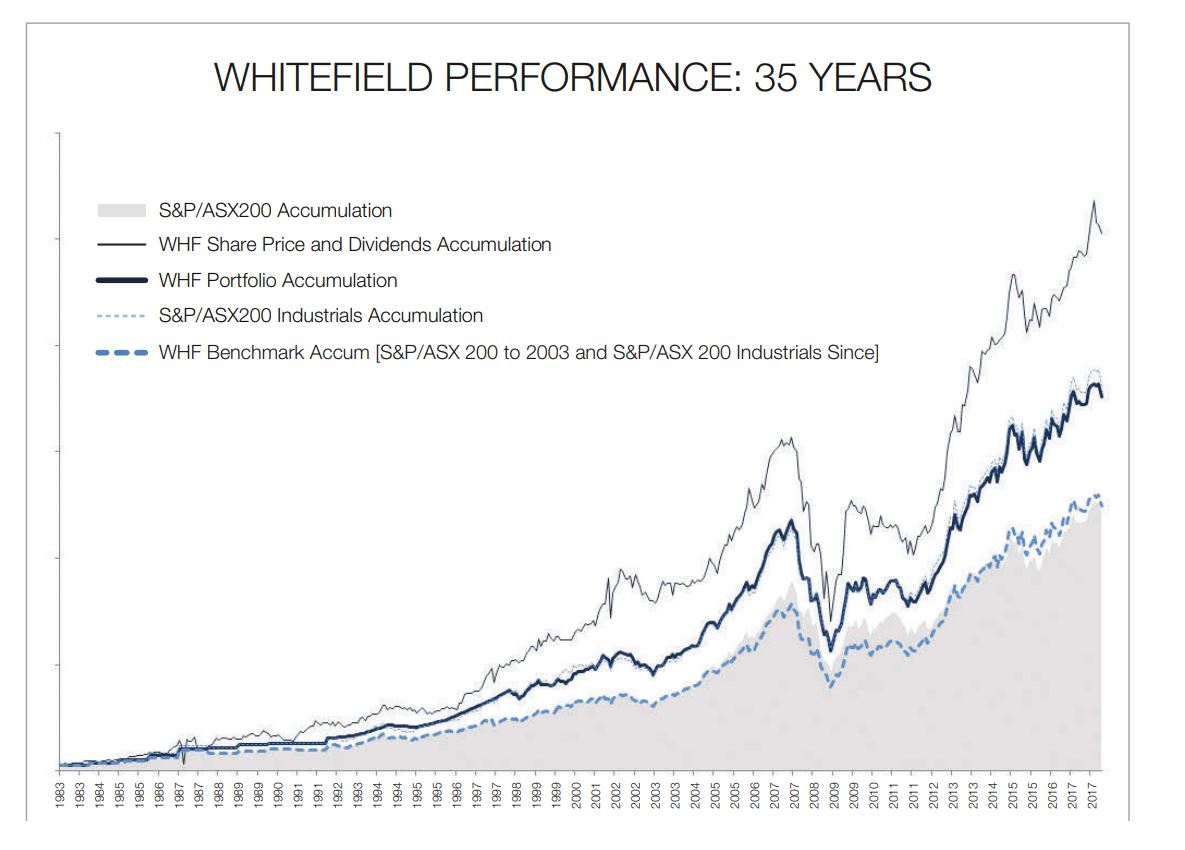
Whitefield has traded at a long term discount to NTA. This due to a number of factors, most likely being the relatively concentrated nature of the shareholder base (lower liquidity for large buyers), the unique industrial only strategy, lack of a share buyback and general unawareness of the company. In recent times the Industrials only strategy has under-performed the wider ASX200 due to the strong growth of resources stocks, however how long this lasts given resources cyclical nature is anyone’s guess.
ASX Dividend Aristocrat Analysis
Overall Whitefield presents an attractive option for investors who are looking for long-term dividend income and growth with a conservative strategy of Industrials only. The management of Whitefield have demonstrated that they can effectively manage the capital to periodically increase dividends and increase the value of the underlying the portfolio. Although Whitefield is owned and run by one family, we see this as a positive, as management have vested interests in seeing the company run well. Given the strong recent run-up in resource stocks, the fund has under-performed the wider ASX200 index, however has kept up with the ASX200 Industrials only index. This has led to a widening of the discount to NTA of Whitefield currently sitting at around 10%. This could represent a good entry point as the performance of the Industrials index and wider ASX200 index will ‘flip around’ at some point in the future, leading to an increased popularity of industrial investment strategies and (theoretically) a narrowing of the NTA discount. Of course when this happens is a ‘million dollar’ question.
For investors who have a long time frame, enjoy getting fully franked dividends and believe in the overall value of excluding resources from your investment portfolio then Whitefield limited presents a good option, especially at the current discount to NTA.
 ASX Dividend Aristocrats
Leave a comment